When Working Horses Become Pasture Puffs
Three Means to Retirement
I’d heard the phrase: “Some are born great, some achieve greatness, and some have greatness thrust upon them.” Just found out Shakespeare penned those words (though I’d heard them first from Veggietales). And it got me to thinking that the same could be said for horse retirement.
As the owner of three pasture puffs, with the third retired just last week, the subject has been heavy on my mind. I’ve seen a lot of horses transition to retirement besides my own. Seen it done well, and seen it fail. And tried to do the best for my own.
Those Born Retired
I’ve known quite a few horses in this category. These are the ones born with an inability to work, usually because of a physical impairment. Not many owners can sustain a horse like this; it’s hard to dump money into a horse that stands around all day.
The biggest example that comes to mind is a horse I worked with for quite a few years. Helped raise and pan-feed him. We’ll call him Oli.
Oli’s pretty special. He was born with a cyst in his brain. When he was born, he couldn’t stand, much less try to nurse. His little body was continually wracked with seizures. He could hardly breathe. He went immediately to the nearest equine hospital and spent the first couple months in his life in ICU.
Most owners, myself included, could not afford Oli’s care. His owner, having more than enough means, decided that, since Oli was still fighting to hang on, that he deserved a chance. And against the odds, he fought hard and got better.
The seizures stopped. His breathing improved. The vet and barn teams helped him to learn to walk and stand. When we brought him home, we made him a special padded stall so he wouldn’t hurt himself as he toddled around. Every day, he’d get wheeled outside on a special cart so he could practice walking in the grass—supported by a dog harness with a person on each side to hold him up.
Oli is by no means an ordinary horse. That much is obvious if you watch him giraffe-lope across the pasture. But he’s probably the happiest horse I’ve ever known. He doesn’t know he’s different. He likes to play, often carrying his jolly balls around the pasture and setting them in neat little groups. He loves interacting with people; if you call his name, he’s sure to come running.
There’s a good case to be made for putting Oli down even now. He’s not the safest to be around. Everyone who handles him has to be mindful of that. But as long as he’s not too dangerous and has good quality of life, he’ll stick around for now.
Oli was never destined to be a riding horse, so he came out retired. Not that it means inactivity on his part or on the part of his handlers. He still had to be trained to do normal horse things. And he has a job of sorts. He’s a teacher. I know of at least one study written about his condition. And that’s the primary reason the owner decided to keep him alive; he provided a learning opportunity.
As the only horse alive with his condition—that I know of—perhaps Oli can shed further light on future horses born with brain cysts. Maybe there will be a cure to his condition someday, and it started with him.
Those that Achieve Retirement
At the end of a horse’s career, they’ve earned their rest. This may not necessarily mean they stop being ridden, but their days of hard competition and work are over. It’s easy to feel good about this retirement.
This applies to Jet, my oldest horse. He’s thirty now, but I chose to retire him several years ago. He’d been showing signs of arthritis, and while he was more than willing to keep going on rides, I decided that the best thing for him would be rest. He’d earned the right to be an old man.
Jet’s as cowy as they come, and while we were still riding together, we’d have fun practicing on the occasional renegade steer. All I had to do was point Jet to the right steer and drop the reins. He’d do the rest.
Now, Jet is living the good life. He’s in a smaller pasture overnight, and during the day, I let him out to have the run of most of the property. I know I can trust him to stay out of trouble. No worries about him stepping in cattle grates or trying to go through fences. He waddles around to graze, visit the neighbor’s horses over the fence, checking out the cows, or hanging out with our mini horses.
For the dressage horses I worked with, their retirement meant they would no longer participate in the sport. One still works as the owner’s riding horse; he doesn’t need to do much but trot around and keep the older woman safe. Others get turned out to pasture to hang out with other horses; often for the first time in years. They’ve more than earned the right to play and just be a horse.
The Ones that Have It Thrust Upon Them
This path to retirement is the hardest to swallow. Something happens—something breaks—to force a horse out of their riding career. I’ve been walking through it recently with Luka, my youngest who recently turned 17.
Several months ago, Luka started exhibiting signs of behavioral changes and increasing neurological symptoms. At first, I thought it was his teeth bugging him, but a dental exam (and a sinus scope), ruled that out.
Maybe an EPM flareup. The blood results nixed that.
Metabolic changes? Nope, his insulin and ACTH levels were normal.
I finally took him to see a neurological specialist. She had some ideas, which would require more expensive diagnostics. This wasn’t in the budget; I’d rather have money to spend on treatment. Which she was more than willing to support.
But she also dropped a bombshell.
Luka is no longer safe to ride. He is ataxic enough that riding would be dangerous for both of us. It still feels like a gut punch.
All kinds of thoughts filled my head. Not just treatment. But what if treatment doesn’t work? He’s so young, I hate to think about the final decision. It’s still floating around in the back of my mind, but at least there’s still treatment to try that’s within my budget.
So Luka’s set up with a couple different medications to alleviate his symptoms. And I got him neck injections last week. And, thank God, they seemed to have helped. I’m seeing signs of my boy again.
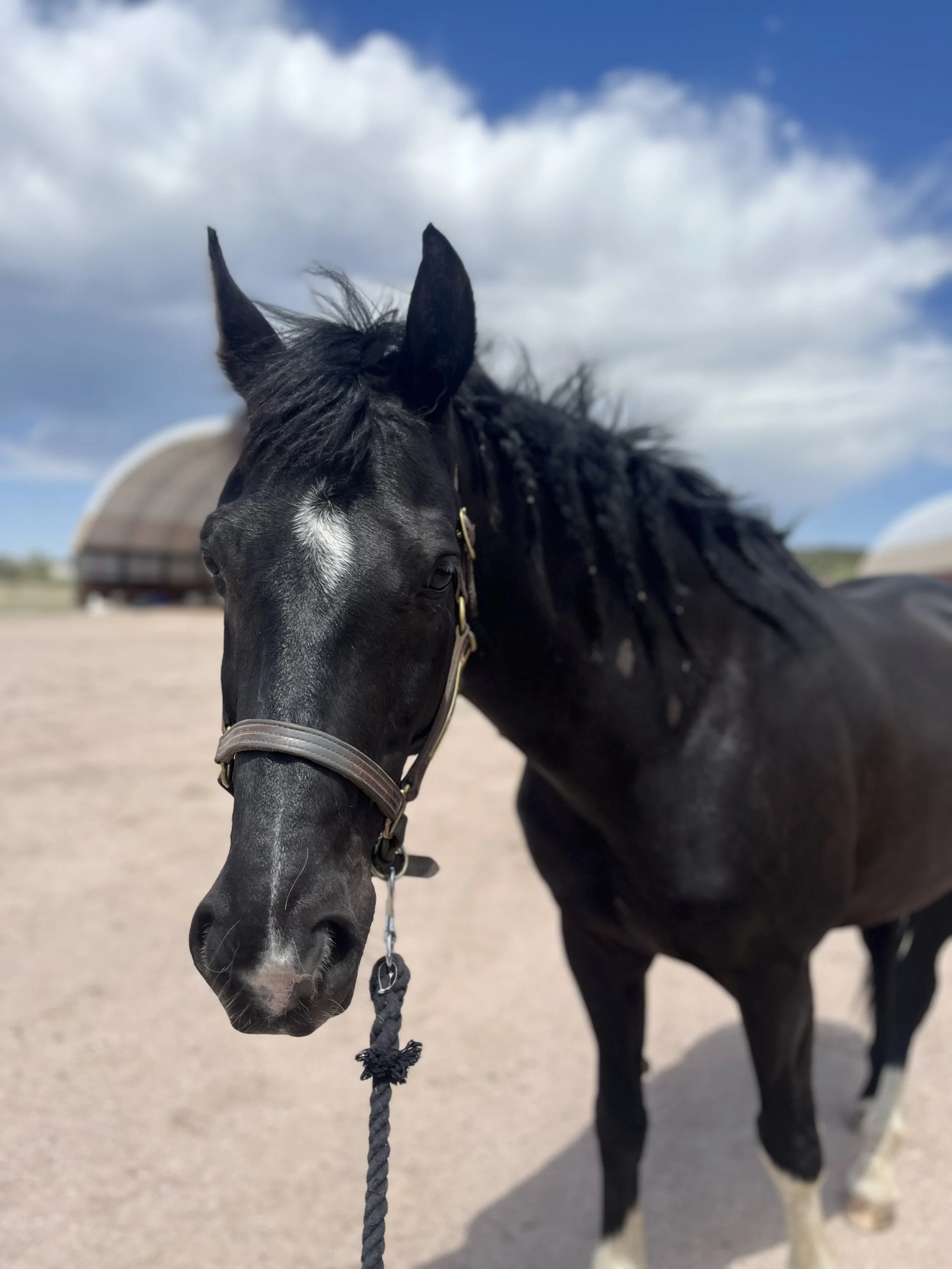
While Luka had been growing spookier and more aloof, he’s now starting to engage more with me again. He comes up for cuddles and doesn’t shy away from my touch. He’s moving more comfortably. He’ll stay a pasture puff, but as long as it’s feasible to keep him comfortable and me safe, he’ll stay with my herd.
Forced retirement, often due to injury, is heart-rending. Especially if it’s something that couldn’t be prevented.
Retirement Considerations
When you retire a horse, I encourage you to not just toss them outside and walk away. They’ve given much of their lives to connect with and support people. They deserve continuing care.
Though I don’t ride my retirees anymore, they still get attention beyond mandatory vet and farrier care. With keeping my guys at home, I’m out there several times a day to feed. I’m closely involved with their care. I groom them regularly (much to Jet’s disgust; he hates being brushed). I bring treats. Since I have bodywork training, I give them little massages. Sometimes I’ll just bring out a chair and sit close by while I read.
If your horse is kept in a boarding situation, you can still show your retiree some love. Grooming is great. So are cookies (low sugar for the metabolic kiddos). Or maybe some handwalks and hand grazing.
I’ve seen retirement go wrong, too. Faithful horses tossed out to pasture, forgotten unless something catastrophic happens.
I never want that for a horse. It’s a horrific thing to watch. Worse to be able to do nothing.
Especially if you’ve had your horse for a while, you’ve formed a bond. Horses are very relational animals; I think they understand a lot more than we give them credit for. A well-earned retirement, accompanied by continuing love and care, ensures a good transition into a horse’s golden years.